Self-Balancing Robot
A two-wheeled self-balancing robot built end-to-end — then three ways to keep it upright: cascaded PID, imitation learning, and RL.
▶It Actually Balances
Live demo — the robot recovering and holding balance in real time.
▶Three Ways to Stay Upright
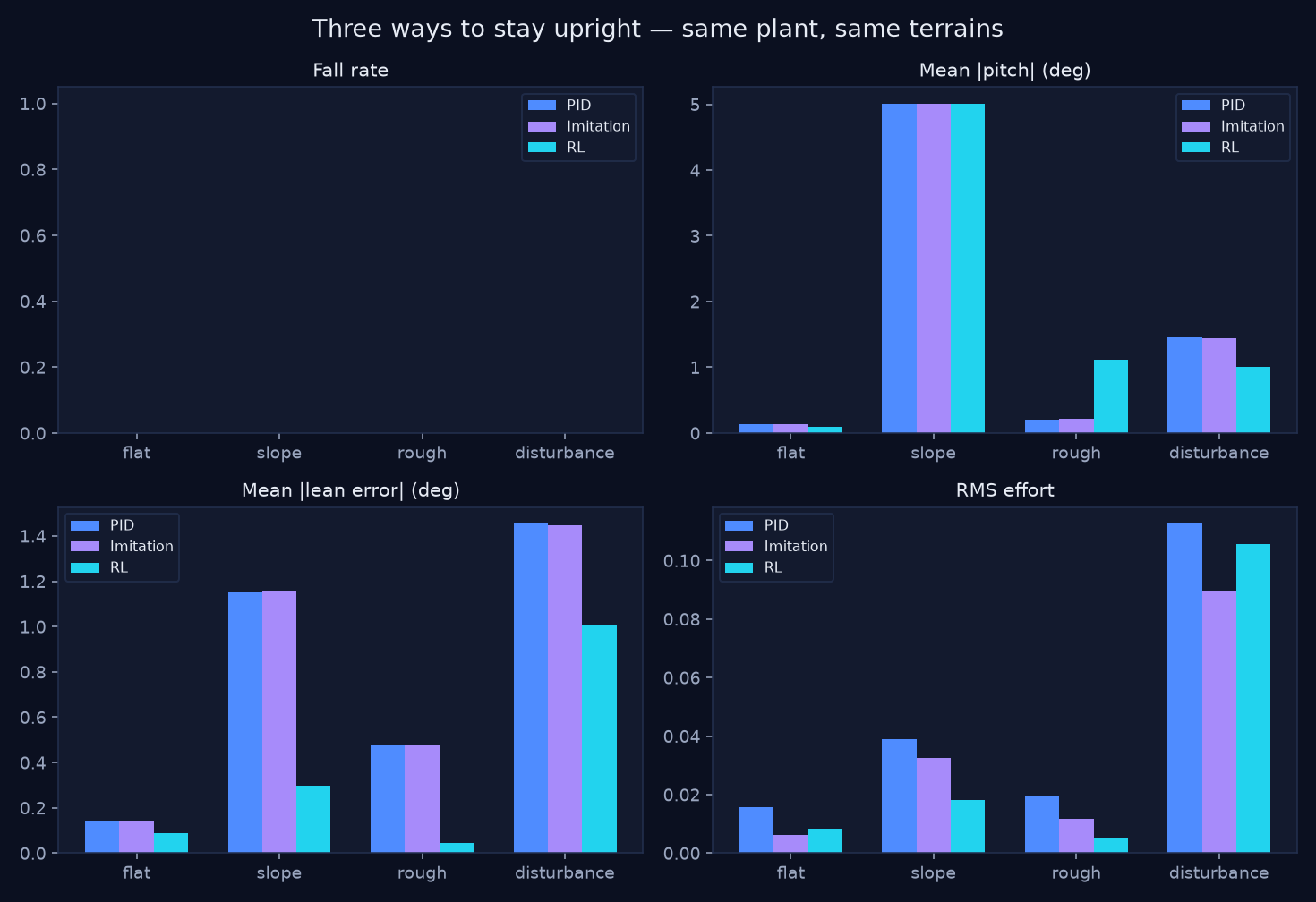
Same simulated plant, four terrains, three controllers — orbit camera and a live metrics picture-in-picture. Traditional PID, then an imitation of that expert, then an RL policy held fixed while the ground changes (flat → grade → rough → shove).
Same plant, same four terrains. Imitation matches PID. RL cuts lean error on the grade and tracks rough ground — a strategy nobody typed in.
iOverview
This project implements a two-wheeled self-balancing robot using an advanced (cascaded) PID control policy. The robot estimates its body angle and continuously adjusts motor output to maintain balance, forming a closed-loop control system similar to the basic principle behind Segway-like robots.
It combines hardware integration, sensor feedback, real-time control, and parameter tuning — demonstrating how classical control methods can stabilize an inherently unstable physical system, and laying a foundation for more advanced topics such as state feedback, trajectory tracking, and model-based control.
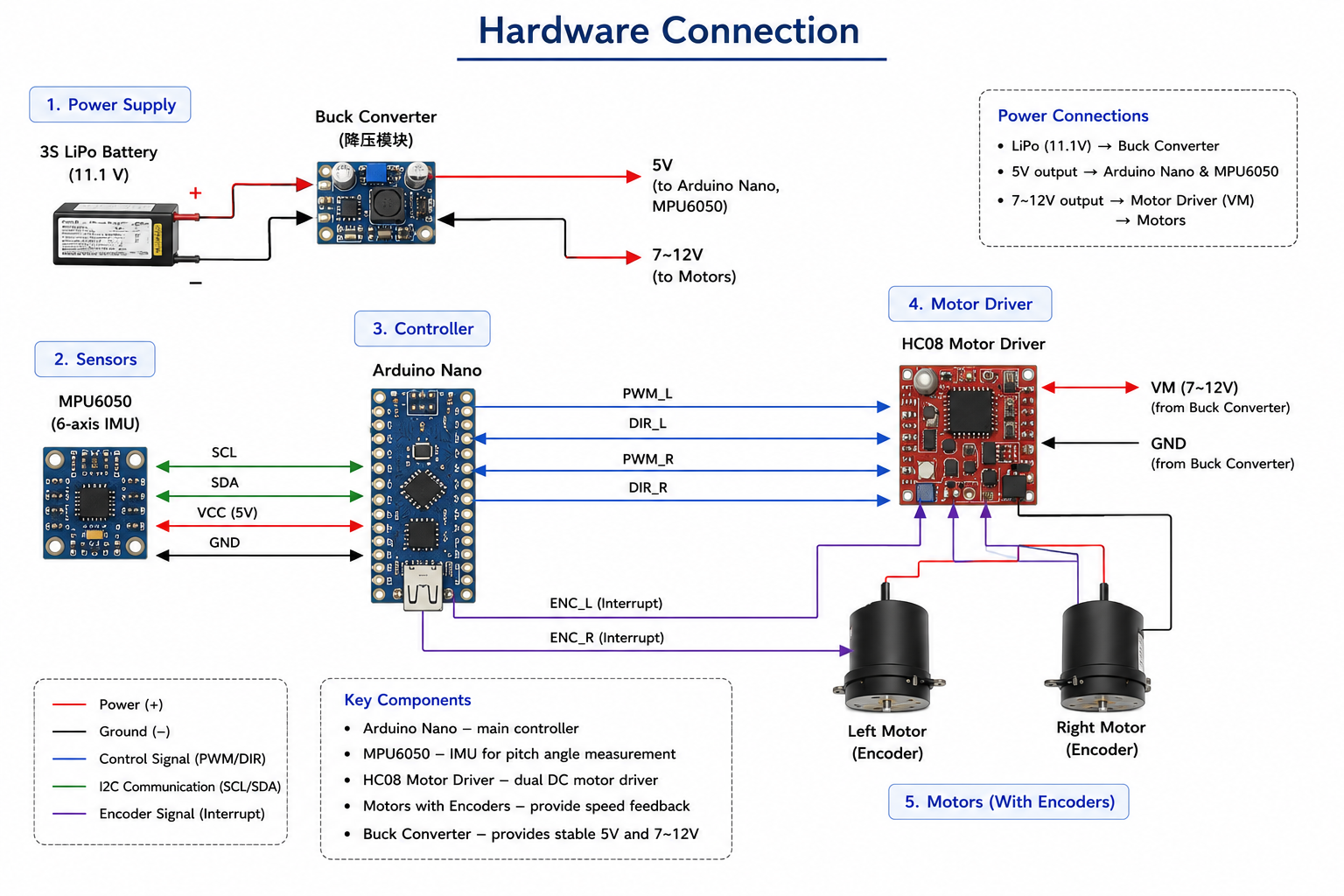
1Hardware Connection
Power regulation, sensors, controller, motor driver, and encoder-equipped motors.
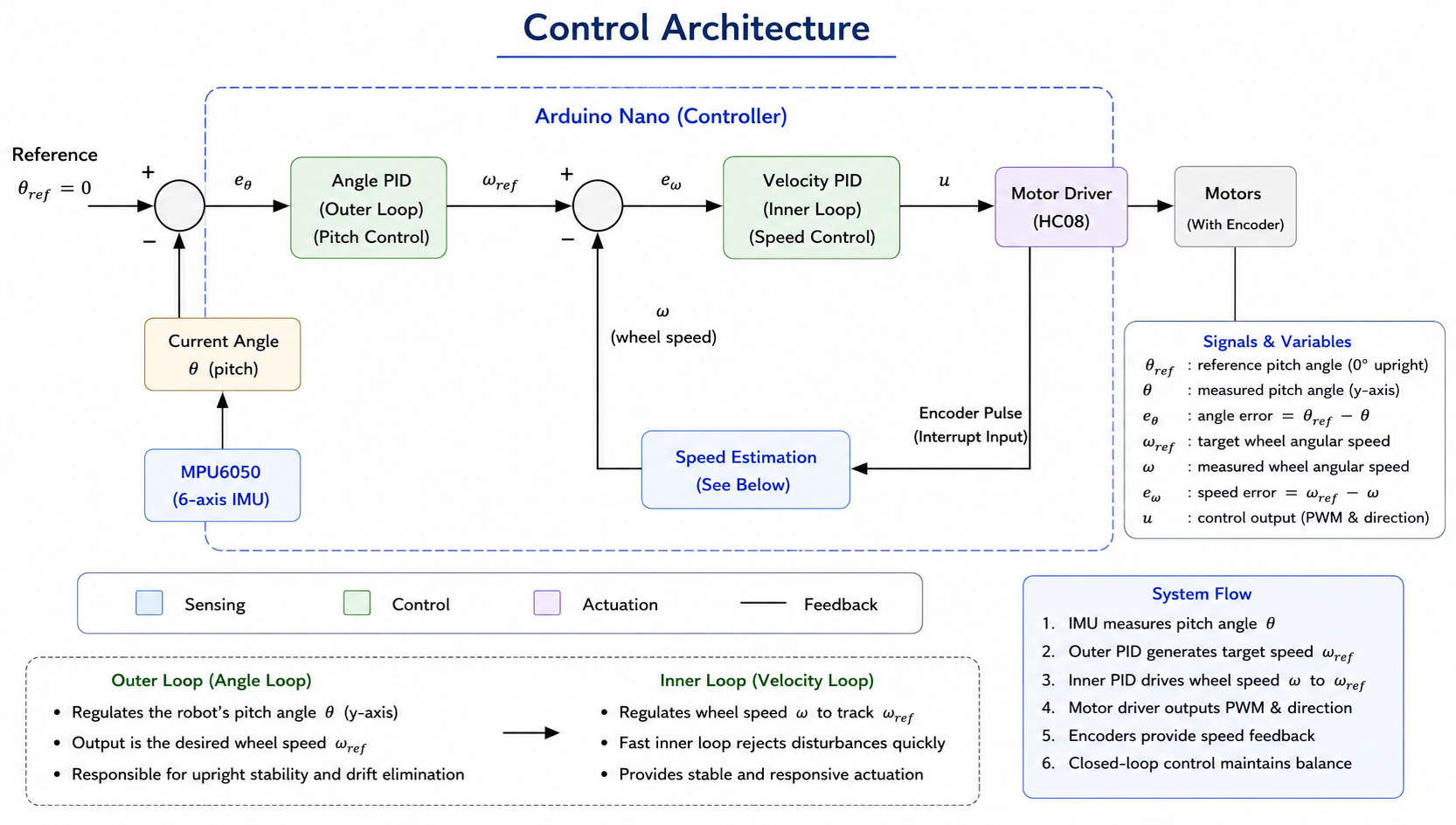
2Control Architecture
Cascaded loops: an outer angle (pitch) loop feeding an inner velocity loop.
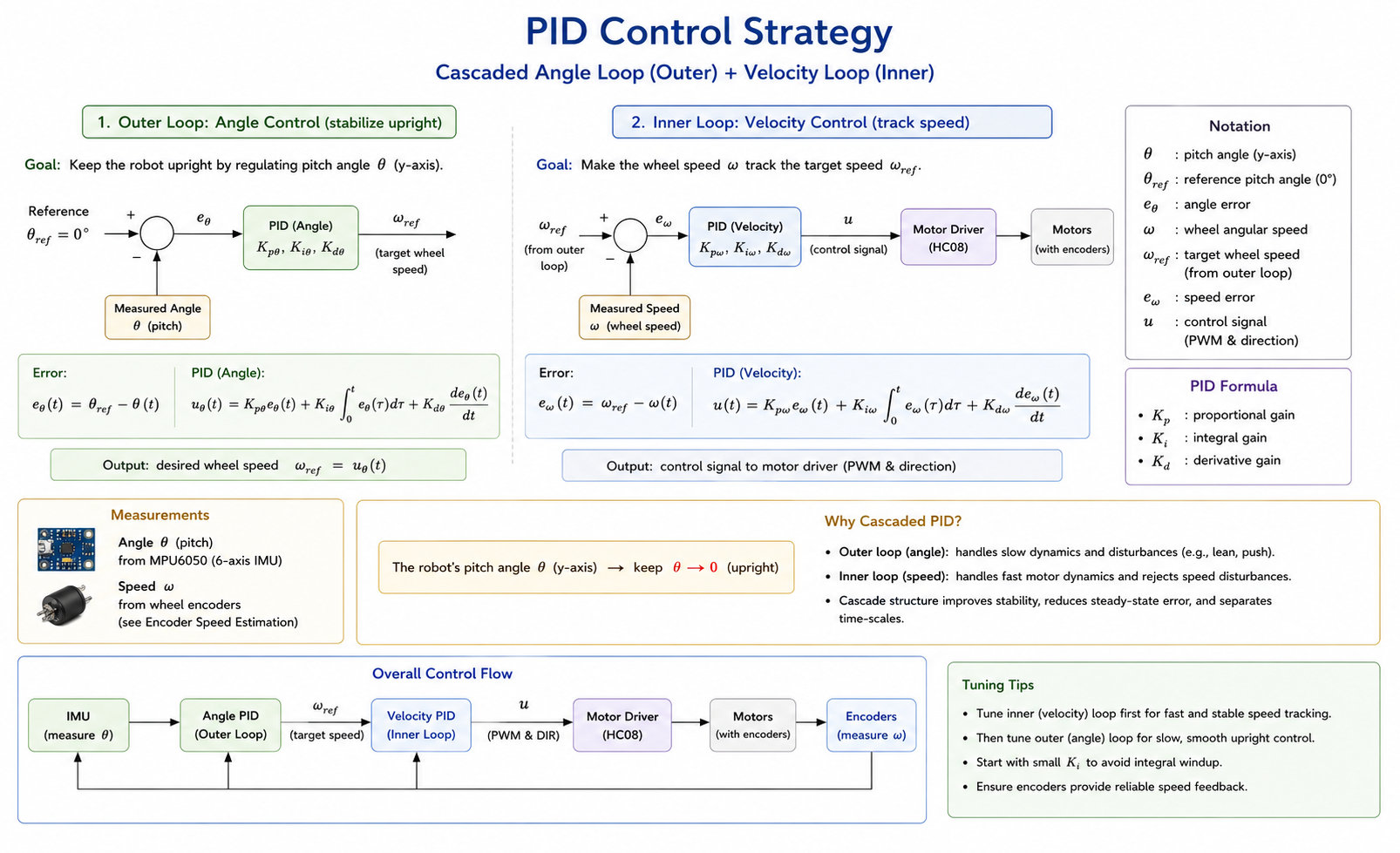
3PID Control Strategy
Angle loop stabilizes the robot upright; velocity loop tracks the target wheel speed.
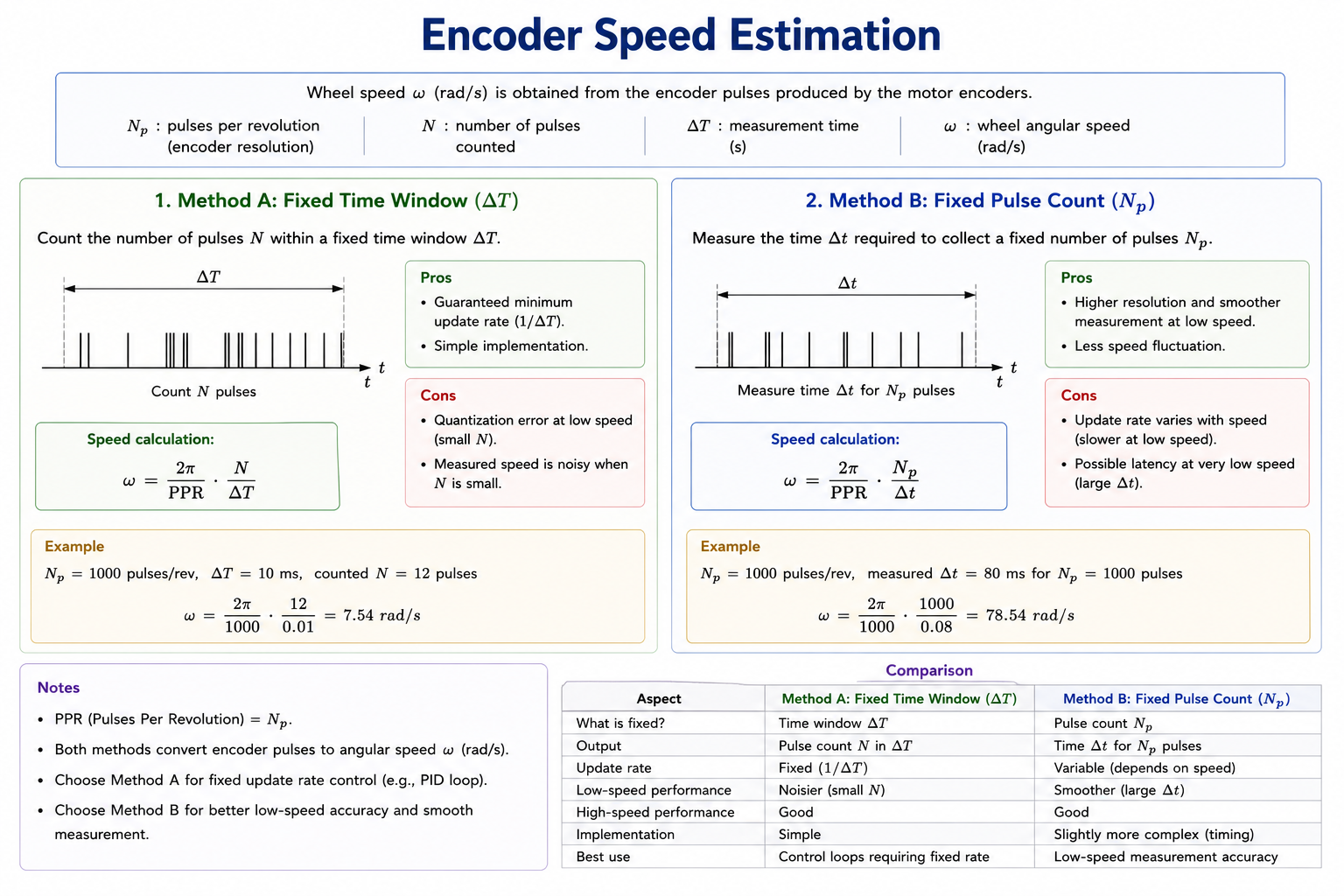
4Encoder Speed Estimation
Two interrupt-driven methods — fixed time window vs. fixed pulse count — with a trade-off comparison.
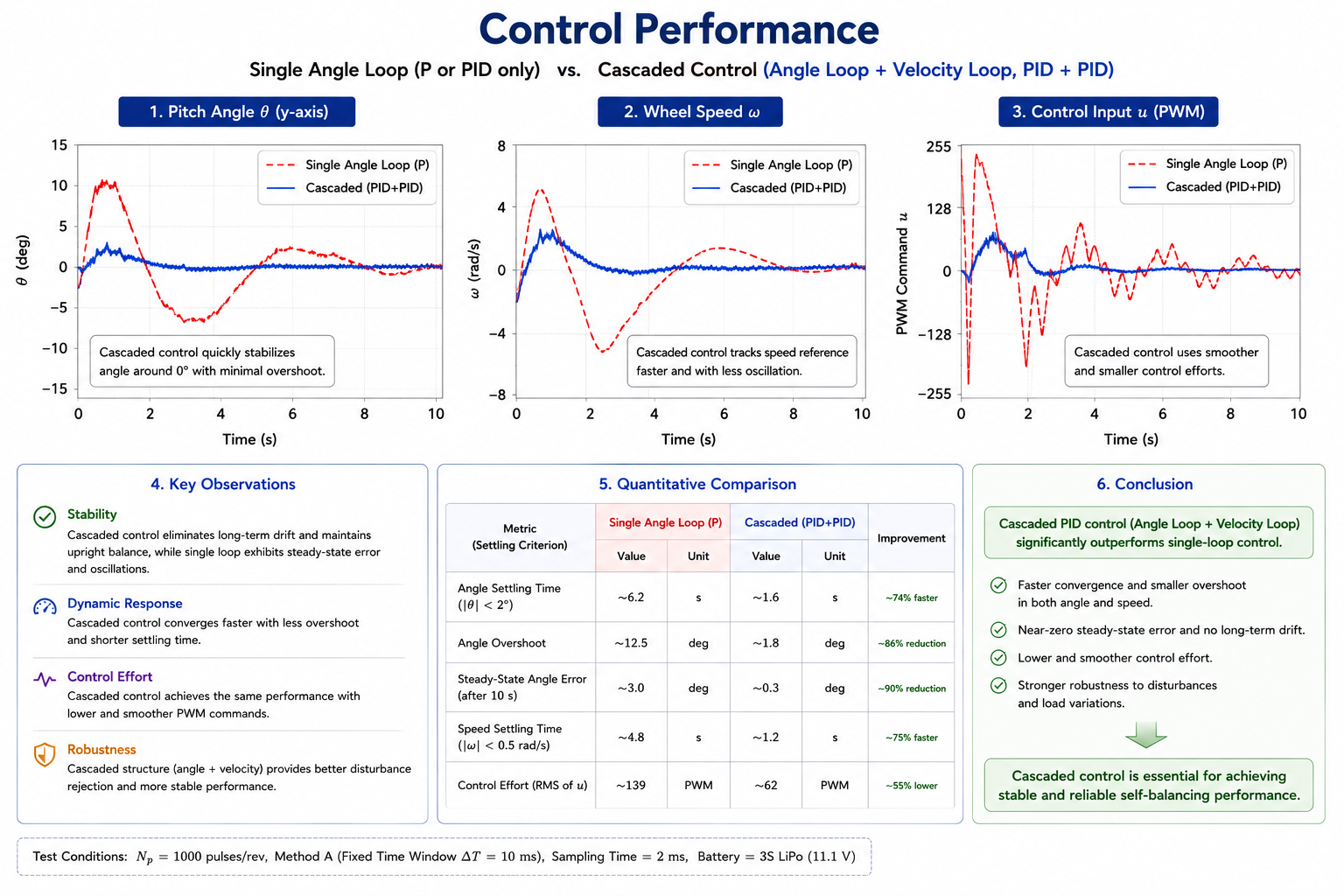
5Control Performance
Single angle loop vs. cascaded control — angle, wheel speed, and control effort.
+Highlights
- Engineered a self-balancing robot integrating an Arduino Nano, MPU6050 IMU, HC08 motor driver, encoder-equipped DC motors, and power regulation into a real-time embedded control platform.
- Designed a dual-loop PID controller regulating pitch angle through nested angle and velocity feedback, eliminating the long-term drift seen with single-loop balancing and improving recovery robustness.
- Implemented interrupt-driven encoder processing with both fixed-time and fixed-pulse velocity estimation, evaluating their responsiveness and noise characteristics for reliable motor feedback.